Hilbert’s palette

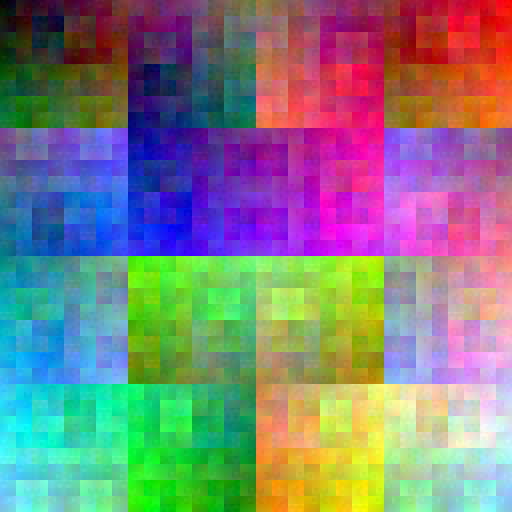
A space-filling path through this square is matched to an analogous path through the color-cube.

I had this idea in mind for years but the algorithm for Hilbert’s curve defeated me; then I stumbled on Steve Witham’s Python code, and whipped up this doodle in half an hour.

Posted in eye-candy, mathematics | 4 Comments

Incandescence

In Greg Egan’s latest novel, as is not uncommon in first contact novels, the chapters alternate between the viewpoints of a human explorer and a member of the newly discovered species. In defiance of convention, Rakesh never finds Roi’s world. (There is room for a sequel, but I don’t expect one.) Roi lives in a tiny artificial world orbiting a black hole, and Rakesh finds a similar world orbiting a neutron star.

So why is Roi in the book? Because she is a leader in the blossoming of science in her world – going from pretechnological ignorance to general relativity in one lifetime, thanks to the peculiar environment – while the world contacted by Rakesh is stagnant.

Posted in prose | 1 Comment

chaos and health

In a private forum, Rafal Smigrodzki wrote:

I remember that one of my early epiphanies on the road to libertarianism came when I was reading about chaotic, scale-independent oscillations in heartbeat frequency. One might naively think that the healthier the heart, the more regular its beat – but actually the opposite is true. A healthy heart chaotically wanders around a setpoint, as a result of interactions of millions of locally coupled oscillators, the spontaneously spiking cells in the AV node. But as you press your heart harder and harder, as in heart failure, the chaotic rhythms are becoming simpler, until one last AV frequency remains, usually quite high, tachycardic, produced by an ever smaller set of cells. The next step may be fibrillation, or asystole, and death.

So, in our hearts health comes from chaos, the absence of a rhythm for every cell to dance by. Networked interactions can be made much more robust using multiple, locally interacting oscillators, rather than relying on a single one. The analogies to the society, the share of activities controlled by a single global decision-maker versus multiple local ones are in my mind crystal clear.

Posted in economics, medicine | Leave a comment

how about them links, eh?

I laughed aloud.

Stefan Molyneux on voting

No one could have predicted the housing bubble pop, right?

Posted in cartoons, politics | Leave a comment

a futile protest

Charlie Stross, interviewed in H+ magazine, mentions in passing

. . . the more socially dysfunctional libertarians (who are convinced that if the brakes on capitalism were off, they’d somehow be teleported to the apex of the food chain in place of the current top predators).

I’m curious to see his favorite examples; I hope I, at least, have never (since age ~25) said anything to justify such a crack, beyond indulging in “if I were dictator” daydreams as I assume everyone does.

I can’t imagine a plausible world that would have someone like me at the top of the heap. I’m a libertarian because I’m convinced that the poor and the dysfunctional would live easier in a more open world.

But I can say that until I turn blue, and there will always be someone to call me a liar.

Charlie goes on:

. . . they mostly don’t understand how the current system came about, or that the reason we don’t live in a minarchist night-watchman state is because it was tried in the 18th and 19th centuries, and it didn’t work very well.

For whom? Presumably it disappointed those with the power to change it, before the masses got the vote.
Posted in bitterness, futures, politics | 5 Comments

because you asked for it, or because you didn’t

retro MacOS theme for WordPress. I’m pretty sure this is before it was called MacOS, that’s how old it is. (Hat tip to Bill Detty.)

Posted in blogdom, neep-neep | 1 Comment

Takana go goth

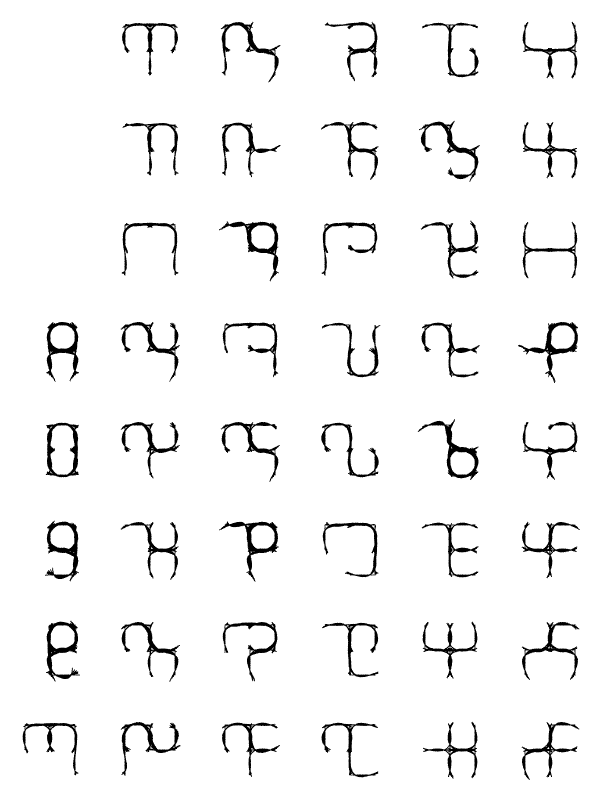
See Takana. The 306 figures shown there can be reduced to 45 by rotation and reflection. I fitted a polynomial curve to each partial path, and superimposed them.

Posted in curve-fitting | 2 Comments