⭳ ©
wrt. {7}
(at margins)
- between {7} and {7}: 79.512670°
- ...
- general polytopal classes:
- Acrohedra
links
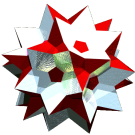

| Acronym | sissicu |
| Name | small supersemicupola |
| VRML |
|
| Circumradius | 1.440130 |
|
Inradius wrt. {7} | 0.863707 |
| Vertex figure | [3,7,3,7/2], [3,72], [3,7,3/2,7/6] |
|
Dihedral angles
(at margins) |
|
| Face vector | 28, 49, 22 |
| Confer |
|
|
External links |
|
This polyhedron was found in 2005 by M. Green. Note that the central part of the heptagram acts as a membrane, i.e. is accessible from both sides.
Because having axial heptagonal symmetry, the numeric values are much harder to derive algebraically. However the above given circumradius (and some further values too) get generally derived for [p,q,q]-acrohedra here by formula.
As abstract polyhedron sissicu is isomorphic to gissicu, thereby replacing heptagons {7} by small heptagrams {7/2} and the small heptagram {7/2} by a great heptagram {7/3}.
7 * * * | 2  2 0  0 0 | 1 2 1 0  [3,7,3,7/2]
* 7 * * | 0  2 1  0 0 | 0 1 2 0  [3,7,7]
* * 7 * | 0  0 1  2 0 | 0 0 2 1  [3,7,7]
* * * 7 | 0  0 0  2 2 | 0 0 2 2  [3,7,3/2,7/6]
--------+-------------+--------
2 0 0 0 | 7  * *  * * | 1 1 0 0  acting like a parallel circle
1 1 0 0 | * 14 *  * * | 0 1 1 0
0 1 1 0 | *  * 7  * * | 0 0 2 0  acting like a meridian
0 0 1 1 | *  * * 14 * | 0 0 1 1
0 0 0 2 | *  * *  * 7 | 0 0 1 1  acting like a parallel circle
--------+-------------+--------
7 0 0 0 | 7  0 0  0 0 | 1 * * *  {7/2}
2 1 0 0 | 1  2 0  0 0 | * 7 * *  {3}
1 2 2 2 | 0  2 2  2 1 | * * 7 *  {7}
0 0 1 2 | 0  0 0  2 1 | * * * 7  {3}
© 2004-2026 | top of page |