Segmentotopes
External
links
|
|
In 2000 Klitzing published[1] on segmentotopes in general resp. his
research on convex segmentochora in special. Segmentotopes are polytopes which bow to the following conditions:
- all vertices on the surface of 1 hypersphere
- all vertices on 2 parallel hyperplanes
- all edges of 1 length
The first condition shows that the circumradius is well defined. Moreover, in union with
condition 3 this implies that all 2D faces have to be regular. The sandwich type 2nd condition implies that all edges,
which aren't contained completely within one of the hyperplanes, would join both, i.e. having one
vertex each in either plane. Thence segmentotopes have to be monostratic. In fact,
segmentotopes are the monostratic orbiforms.
(Orbiforms, a terminus which had been created several years later only, just use the first and third condition of those.)
Finally it follows, that the bases have to be orbiforms, while all the lacing elements have to be (lower dimensional) segmentotpes.
The naming of individual segmentotopes usually is based on the 2 base polytopes: top-base polytope atop
bottom-base polytope. Symbolically one uses the parallelness of those bases: Ptop || Pbottom.
(For the smaller segmentotopes the choice of bases need not be unique.)
Segmentotopes are closely related to lace prisms. In fact those concepts have a large common intersection,
but they are not identical. While lace prisms need an axis of symmetry (in fact one which is describable as Dynkin symbol),
one uses the terminus "axis" in the context of segmentotopes only in the sense of the line defined by the centers of the
circumspheres of d-1 dimensional bases. (Thus the topic of axial polytopes does more relate to lace towers (as
multistratic generalizations of lace prisms) than to segmetotopes. None the less there is a large overlap.)
– Note that the radius R of the d-1 dimensional circumsphere used for a segmentotpal base of dimension d-k might well be larger than the
radius r of its d-k dimensional circumsphere: for k > 1 the latter might well be placed within the former with some additional shift s:
R2 = r2 + s2.
For a simple example just consider squippy, the 4-fold pyramid,
which is just half of an oct, when being considered as line || triangle: the subdimensional base,
the single edge, there is placed off-set.
In fact, let rk be the individual circumradii of the bases, let sk be the respective shifts away from the axis
(if subdimensional), let h be the axial height and R the global circumradius, then we have the following interrelation formula
between all these sizes
4 R2 h2 = ((r22+s22)-(r12+s12))2 + 2 ((r12+s12)+(r22+s22)) h2 + h4.
Convex Segmentochora (up)
Just as polytopes are distinguished dimensionally as polygons, polyhedra, polychora, etc.
so too are segmentotopes.
The only segmentogons (without any further adjectivic restriction) clearly are
- regular triangle (point || line) and
- square (line || line).
Segmentohedra already include infinite series like
(*) Grünbaumian bottom base understood to be withdrawn.
For convex ones d clearly has to be 1 and several of the above series then become finite.
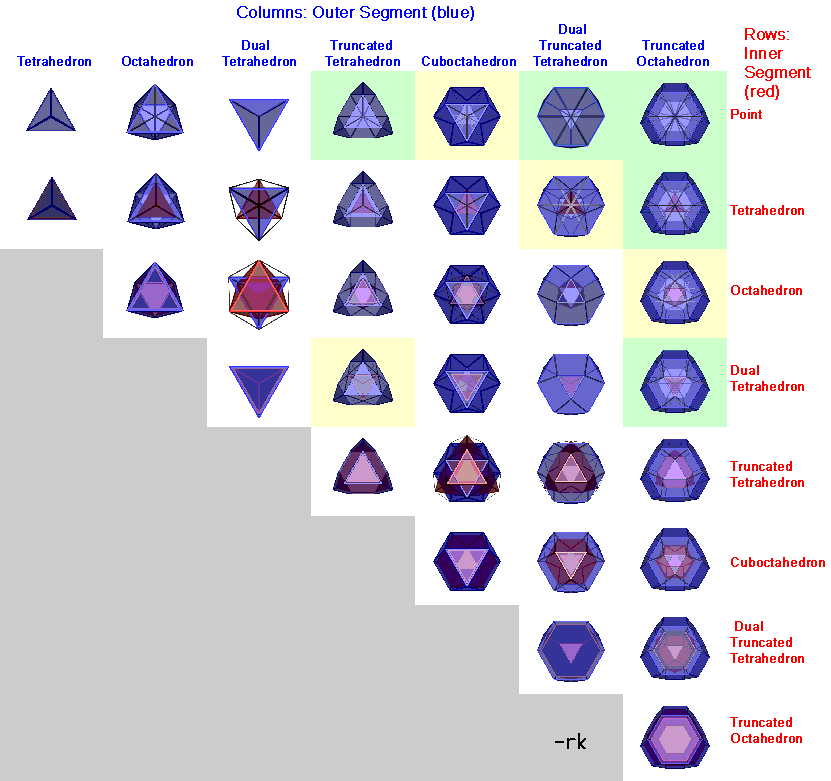
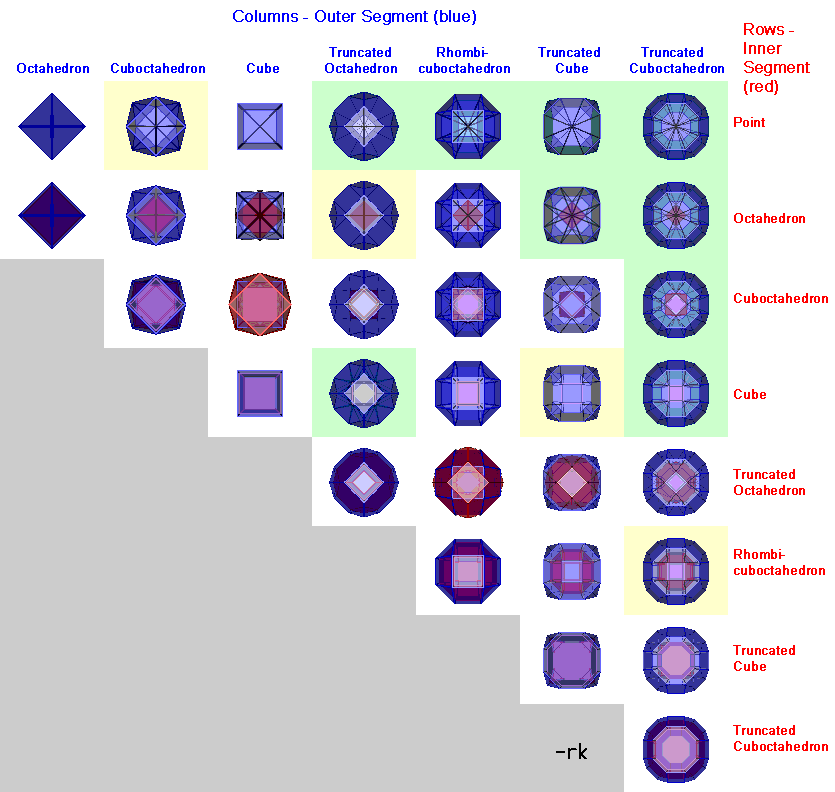
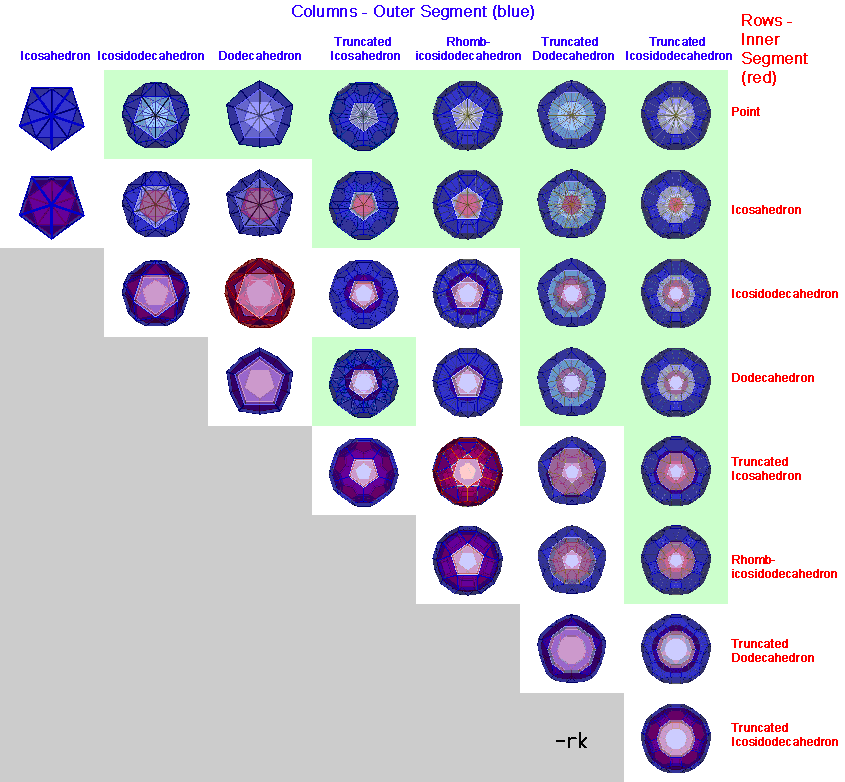
Polychora generally have the disadvantage not being visually accessible. Segmentochora are not so hard for that:
Just consider the 2 base polyhedra displayed concentrically, perhaps slightly scaled, while the lacings then
get slightly deformed. Mathematically speaking, axial projections (view-point at infinity) and central projections (finite view-point),
either one being taken on the axis for sure, from 4D onto 3D generally are well "viewable" for such monostratic figures.
Especially when using real 3D graphics (like the here used VRMLs) instead of further projections onto 2D as in usual pictures:
Note that all pictures at "segmentochoron display" within individual polychoron files will be linked to such VRML files.
Color coding of the following pictures:
red |
- |
Ptop |
blue |
- |
Pbottom |
gold |
- |
lacing edges |
| - |
white |
spherical geometry |
| - |
light yellow |
euclidean geometry – cf. also: decompositions |
| - |
light green |
hyperbolic geometry |
Cases with Tetrahedral Axis:
Cases with Octahedral Axis:
Cases with Icosahedral Axis:
Cases with n-Prismatic or n-Antiprismatic Axis:
Non-Lace-Prismatics:
Just as already often was used within the set of Johnson solids, several of the above segmentochora allow diminishings too.
Those generally break some symmetries of one or both bases, and therefore too of the axial symmetry.
Thus there is no longer a unifying symmetry according to which a Dynkin symbol could be designed,
being the premise for lace prisms.
Even though, such diminished ones are fully valid segmentotopes (following the above 3 conditions).
An easy 3D example could be again line || triangle,
the alternate description of the above mentioned squippy.
The easiest 4D one clearly is squasc
(i.e. the 1/4-lune of the hex).
–
Gyrations in some spare cases might apply as well,
although those in general would conflict to the requirement of exactly 2 vertex layers.
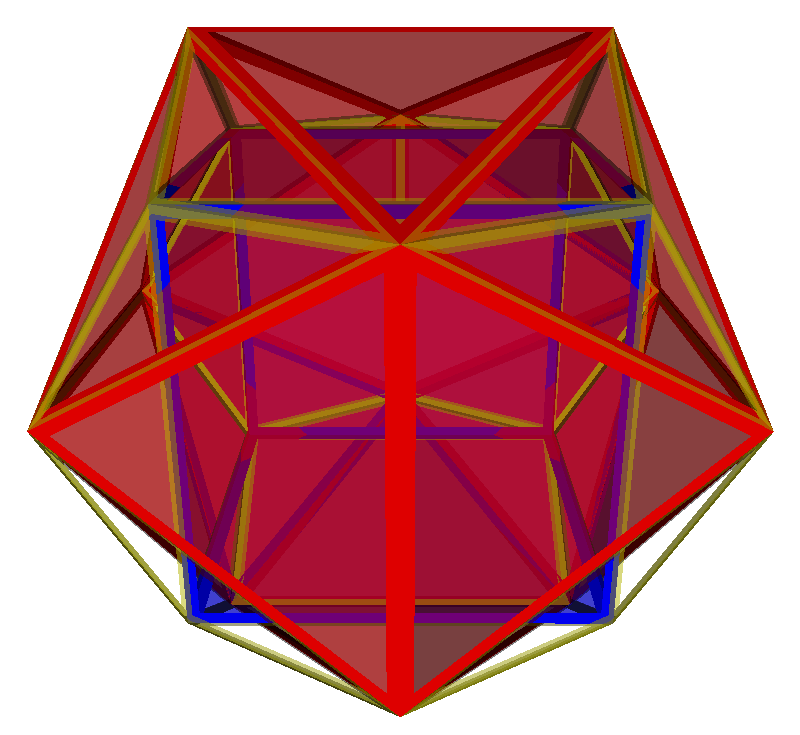
But there is also a generic non-lace-prismatic convex segmentochoron with octahedral symmetry at one base,
with icosahedral symmetry at the other. (The common subsymmetry clearly is the pyrital. But that one does not bow to Dynkin symbol description.)
That one uses as faces
1 cube (as bottom base),
6 trip (as line || square),
12 squippy (as triangle || line),
8 tet (as triangle || point), and
1 ike (as top base).
Full Table:
(For degenerate segmentochora, i.e. having zero heights, cf. page "finite flat complexes".)
Close Relatives:
-
In 2012 two sets of closely related monostratic polytopes where found:
In fact the constraint, of the lacing edges all having unit lengths too, results in some specific shift values for the base polyhedra.
As those base polyhedra on the other hand are not degenerate, this conflicts to having a common circumsphere in general: within the
case of pyramids only the special value n=3 results in a true convex segmentochoron (being the hex), within the
case of cupolae only the special value n=2 results in a true convex segmentochoron
(being trip || refl ortho trip).
Even though, the values n=3,4,5 resp. n=2,3,4,5 would well generate monostratic convex regular-faced polychora (CRFs).
The closeness even could be pushed on a bit. If one of the (equivalent) bases each, which are segmentohedra in turn,
would be diminished by omitting the smaller top face, i.e. maintaining therefrom only the larger bottom face,
those would re-enter the range of valid segmentochora again:
{n} || gyro n-py resp. {2n} || n-cu.
In fact, here the necessary shifts of the bases could be assembled at the degenerate base alone. There a non-zero shift is known to be allowed.
Without narrowing those findings, those 2 families could be de-mystified a bit by using different axes:
the pyramidal case is nothing but the bipyramid of the n-antiprism, while the cupolaic case is nothing but the bistratic lace tower
xxo-n-oxx oxo&#xt.
Later the author realised also the existance of their ortho counterparts:
Again those can be splitted at their now always prismatic pseudofacial equator
For the pyramidal ones, the case n=2 becomes subdimensional, there representing nothing but the oct.
The general case here is nothing but the n-prismatic bipyramid.
For the cupolaic case N=2 clearly is full dimensional, but pairs of contained squippies become
corealmic and thus unite into octs. Therefore that case happens to become nothing but
ope.
-
In 2014 three close relatives to pyramids have been found, which are not orbiform just because their base is not.
Those are line || bilbiro, {3} || thawro, resp.
{5} || pocuro. A further such case would be line || esquidpy.
-
Besides of considering 2 parallel hyperplanes cutting out monostratic layers of larger polychora, in 2012 (and more deeply in 2013)
considerations about 2 intersecting equatorial hyperplanes were done. Those clearly cut out wedges. The specific choice of those hyperplanes
made up the terminus lunae. Only the CRF ones were considered. The following
lunae are known so far:
- Lunae of hex: cells being squippy and tet
- 1/4-luna of hex = squasc = pt || squippy
(thus a segmentochoron) – hyperplanes intersect at 90°.
- Lunae of ico: cells being tricu, oct, and
squippy
- 2/6-luna of ico = oct || tricu
(thus a segmentochoron) – hyperplanes intersect at 120°.
- 1/6-luna of ico = {3} || gyro tricu
(thus a segmentochoron) – hyperplanes intersect at 60°.
- Lunae of ex: cells being pero, peppy, and
tet
- Lunae of spid resp. gyspid: cells being tricu,
tet, and trip
- 0.290215-luna of spid = tet || tricu
(thus a segmentochoron) – hyperplanes intersect at arccos(-1/4) = 104.477512°.
- 0.209785-luna of spid = {3} || tricu
(thus a segmentochoron) – hyperplanes intersect at arccos(1/4) = 75.522488°.
- 0.419569-luna of gyspid = {3} || tricu || {3}
– hyperplanes intersect at 2 arccos(1/4) = arccos(-7/8) = 151.044976°.
- Lunae of quawros: cells being squacu, cube, tet, and trip
- Lunae of stawros: cells being pecu, pip, tet, and trip
-
Surely the convexity restriction could be released.
Some 3D examples can be found on the page on axials.
Some 4D cases would be e.g.
-
0.591923 - gissidpy = pt || gissid = oo3oo5/2ox&#x
-
0.613502 - quithpy = pt || quith = oo3ox4/3ox&#x
-
0.618034 - gikepy = pt || gike = ox3oo5/2oo&#x
-
0.618034 - sissidpy = pt || sissid = ox5/2oo5oo&#x
-
0.618034 - stasc = line || perp {5/2} = xo ox5/2oo&#x
-
0.618034 - gissidragike = narrower gissid || gike = ox3oo5/3xo&#x
-
0.618034 - shallower gissidasissid = gissid || sissid (with lacing starps)
-
0.621876 - ogasc = line || perp {8/3} = xo ox4/3ox&#x
-
0.658240 - shasc = line || perp {7/2} = xo ox7/2oo&#x
-
0.662791 - gissidagike = taller gissid || gike = ox3oo5/2xo&#x
-
0.662791 - taller gissidasissid = gissid || sissid (with lacing staps)
-
0.662791 - stapepy = point || stap = oxo5/2oox&#x
-
0.692924 - gissidagid = gissid || gid = oo3ox5/2xo&#x
-
0.726543 - gikagid = gike || gid = xo3ox5/2oo&#x
-
0.707107 - hossdap = pseudo sissid || pseudo sissid = reduced( β2β5o5/2o , by β5o5/2o )
-
0.707107 - starpglassit = stappy || inv stappy = xooo5/2ooxo&#xr
-
0.707107 - tho = tet || dual pseudo tet = hemi( x3o3/2o3o3*a )
-
0.707107 - fitetaltet = faceted tet || dual tet = reduced( xx3/2ox3oo&#x , by x3/2x )
-
0.739539 - quith || "thah-squares star" = reduced( xo4/3xx3/2ox&#x , by oct )
-
0.774597 - tutrippapy = pt || tutrip = reduced( oox4/2oxx&#x , by ..x4/2..x )
-
0.774597 - tubidrap = pseudo {4} || so = reduced( oxx4/2xox&#x , by ..x4/2..x )
-
0.774597 - firp = tet || pseudo 2thah = reduced( xx3/2oo3ox&#x , by x3/2o3x )
-
0.774597 - fitetaoct = faceted 3tet || oct = reduced( ox3/2xx3oo&#x , by x3/2x )
-
0.774597 - hotetahoct = pseudo tet || pseudo oct = reduced( xx3/2ox3oo3*a&#x , by x3/2x )
-
0.774597 - pafirp = tet || "thah-squares star" = reduced( xx3/2xo3ox&#x , by x3/2x )
-
0.774597 - {3} || pseudo gyro trip = reduced( ox xx3/2ox&#x , by x3/2x )
-
0.780850 - tistadip = {5/2} || stip = x3o x5/2o
-
0.790569 - tutepe = pseudo {4} || {4/2}-prism = reduced( ox xo4/2xx&#x , by x.4/2x. )
-
0.791345 - tistodip = {8/3} || stop = x3o x8/3o
-
0.825168 - stappip = stap || stap = x s2s5/2s
= narrower stip || stip = xx xo5/2ox&#x
-
0.866025 - "coord-axes edge star" || cube
-
0.874032 - stacupe = stip || 2pip = xx5/2ox&#x
-
0.874032 - quit sissidagird = quit sissid || gird = reduced( ox5/4xx5/3xx&#x , by x5/4x )
-
0.879465 - "thah-squares star" || cube
-
0.881132 - sistadip = stip || stip = x4o x5/2o
-
0.890446 - cubaquerco = cube || querco = ox3/2oo4xx&#x
-
0.890446 - sistodip = stop || stop = x4o x8/3o
-
0.912871 - "coord-planes square star" || cube
-
0.951057 - sidtidap = sidtid || gyro sidtid = xo5/2ox3oo3*a&#x
-
0.951057 - gidtidap = gidtid || gyro gidtid = xo5/4ox3oo3*a&#x
-
0.951057 - ditdidap = ditdid || gyro ditdid (the blend of the latter 2)
-
1 - sidtidpy = pt || sidtid = xo3oo3oo5/2*b&#x
-
1 - gidtidpy = pt || gidtid = xo3oo3/2oo5*b&#x
-
1 - ditdidpy = pt || ditdid = xo5oo3/2oo5/2*b&#x
-
1 - tetacho = tet || cho = reduced( ox3/2ox3xx&#x , by x3/2x )
-
1 - hotet aoho = pseudo 2tet || oho = reduced( xx3/2oo3ox3*a&#x , by x.3/2o.3o.3*a )
-
1 - sissidagad = sissid || gad = xo5/2oo5ox&#x
-
1 - co retro-cuploid = "thah-squares star" || co = reduced( ox3/2xx4oo&#x, by .x3/2.x4.o )
-
1 - hoctaoho = pseudo 2oct || oho = reduced( xx3/2xo3ox3*a&#x, by x.3/2x.3o.3*a )
-
1 - octacho = oct || cho = reduced( ox3/2xx3ox&#x, by x3/2x )
-
1 - hothahacho = pseudo thah || cho = reduced( xx3/2ox3xx&&#x, by x3/2x )
-
1 - gikaike = gike || ike
-
1 - sirgikaike (edge-faceting of gikaike)
-
1 - girgikaike (edge-faceting of gikaike)
-
1 - cubagike = cube || gike
-
1.064815 - gaddadid = gad || did = xo5ox5/2oo&#x
-
1.064815 - sissidadid = sissid || did = oo5ox5/2xo&#x
-
1.082392 - quithaquitco = quith || quitco = ox3xx4/3xx&#x
-
1.120533 - tiggia gaquatid = tiggy || gaquatid = xx3xx5/3ox&#x
-
1.136572 - gidtidagiid = gidtid || giid = oo3/2ox3xx5*a&#x
-
1.183216 - ohoa hotut = oho || pseudo 2tut = reduced( xx3/2xo3xx3*a&#x, by x.3/2x.3o.3*a )
-
1.183216 - choatut = cho || tut = reduced( ox3/2xx3xx&#x, by x3/2x )
-
1.328131 - gaddaraded = gad || raded = xx5oo5/2ox&#x
-
1.336349 - dida raded = raded || tigid = xx5ox5/2xo&#x
-
1.414214 - didadoe = did || doe = reduced( oo5xx5/2ox&#x, by x5/2x )
-
1.414214 - goccoa cotco = gocco || cotco = xx3ox4xx4/3*a&#x
-
1.432173 - radedadoe = raded || doe = reduced( ox5xo5/2xx&#x , by x5/2x )
-
1.618034 - gadadoe = gad || doe
-
1.765796 - siida = siid || gyro siid = xo5/2ox3xx3*a&#x
-
2.363565 - radeda tigid = did || tigid = ox5xx5/2oo&#x
-
2.497212 - sissidaraded = sissid || raded = ox5oo5/2xx&#x
-
3.835128 - sidtidasiid = sidtid || siid = xx5/2oo3ox3*a&#x
-
4.352502 - diddatigid = did || tigid = ox5xx5/2oo&#x
-
4.684471 - gidditdid aidtid = gidditdid || idtid = xx5/3xx3ox5*a&#x
-
... - n/d scalene = line || perp {n/d} = xo ox-n/d-oo&#x
-
...
-
By means of external blends at the bases multistratic stacks can be derived, right in the
sense of lace towers. But in general, orbiformity
thereby is lost. Only few are known, which then still are. Among those clearly are the ones which can be deduced as
multistratic segments of uniform or even scaliform polytopes. But there are
also rare exceptional finds beyond those, e.g.
-
sidrebcu = sissid || (pseudo) did || gad = xoo5/2oxo5oox&#xt
-
...
Further Reading
- ↑
Convex Segmentochora – (PDF)
published as: "Convex Segmentochora", by Dr. R. Klitzing, Symmetry: Culture and Science, vol. 11, 139-181, 2000
-
external link (hosted by J. McNeill)
----
 5D
----
(Just some) Convex Segmentotera (up)
|
|
|
1.322876
|
hacube = shiddip || shiddip      (uniform)

rittip = rit || rit              (uniform)

tutcupip = tuttip || inv tuttip  (segment of rittip)
         = tuta || tuta

tepeatuttip = tepe || tuttip     (segment of rittip)
            = tetatut || tetatut
| |
1.360147
|
tippip = tip || tip (uniform)
| |
1.369306
|
squatut = tuttip || tuttip (uniform)
| |
1.414214
|
pennatip = pen || tip       (segment of rin)

tipadeca = tip || deca      (segment of rin)

octatuttip = oct || tuttip  (segment of sibrid)

sripadeca = srip || deca    (half of sibrid)

hatricu = thiddip || hiddip (half of haco)
| |
1.442951
|
otet = {8} || todip          (uniform)
     = op || lacing-ortho op
| |
1.462497
|
trasnic = snic || sniccup (uniform)
| |
1.485633
|
owoct = todip || {3}-gyro todip (uniform)
| |
1.5
|
decap = deca || deca (uniform)
| |
1.502958
|
rita sidpith = rit || sidpith

sirco acope = sirco || cope
| |
1.513420
|
trasirco = sirco || sircope (uniform)
| |
1.515539
|
tradoe = doe || dope (uniform)
| |
1.518409
|
squasnic = sniccup || sniccup (uniform)
| |
1.567516
|
ocube = sodip || sodip          (uniform)

squasirco = sircope || sircope  (uniform)

sidpithip = sidpith || sidpith  (uniform,
                                 segment of scant)

tessasidpith = tes || sidpith   (segment of scant)

squicuffip = squicuf || squicuf (wedge of sidpithip)
           = tes || op
| |
1.569562
|
squadoe = dope || dope (uniform)
| |
1.583946
|
toa sircope = toe || sircope
| |
1.618035
|
idadope = id || dope
| |
1.620185
|
ritag thex = rit || gyro thex (segment of sirhin)

thexa = thex || gyro thex     (scaliform,
                               segment of sirhin)

teta tuttip = tet || tuttip   (segment of sirhin)

rapadeca = rap || deca        (segment of sirhin)

deca aprip = deca || prip     (segment of sirhin)

tutcupa toe = tuta || toe     (wedge of sirhin)
| |
1.632993
|
tipalprip = tip || inv prip (segment of cappix)

tuttipa toe = tuttip || toe (wedge of cappix)
| |
1.658312
|
triddippa hiddip = trddip || hiddip (segment of card)

pripa = prip || inv prip            (segment of card)

sripaprip = srip || prip            (segment of card)

thexip = thex || thex               (uniform)
| |
1.645329
|
otricu = todip || hodip (half of oco)
| |
1.683251
|
tratoe = toe || tope (uniform)
| |
1.688194
|
prippip = prip || prip            (uniform)

tuttipa tope = tuttip || tope     (segment of prippip)
             = tutatoe || tutatoe
| |
1.693527
|
exip = ex || ex      (uniform)

gappip = gap || gap  (uniform)

sadip = sadi || sadi (uniform)
| |
1.695040
|
cuba sircope = cube || sircope
| |
1.717954
|
trid = id || iddip (uniform)
| |
1.719624
|
haop = hodip || hodip (uniform)
| |
1.732051
|
squatoe = tope || tope        (uniform)

icathex = ico || thex         (segment of sart)

thexarico = thex || rico      (segment of sart)

sripalprip = srip || inv prip (segment of sart)

trashiddip = {3} || shiddip   (segment of sart)

cotut totric = co || tutatoe  (wedge of sart)
             = coatut || toe
             = tut || coatoe
| |
1.738546
|
ricoasadi = rico || sadi

doa iddip = doe || iddip
| |
1.765796
|
squid = iddip || iddip (uniform)
| |
1.778824
|
ricoa = rico || gyro rico (scaliform)
| |
1.802776
|
ricope = rico || rico       (uniform)

copatope = cope || tope     (segment of ricope)
         = coatoe || coatoe
| |
1.847759
|
coasircope = co || sircope

ica sidpith = ico || sidpith

ricasrit = rico || srit

ricoaspic = rico || spic
| |
1.848423
|
pripalgrip = prip || gyro grip (segment of pattix)

tutatope = tut || tope         (segment of pattix)
| |
1.870173
|
tratic = tic || ticcup (uniform)
| |
1.870829
|
ritarico = rit || rico   (segment of spat)

spidaprip = spid || prip (segment of spat)

pripagrip = prip || grip (segment of spat)

gripa = grip || inv grip (segment of spat)

copatoe = cope || toe    (wedge of spat)
| |
1.910497
|
grippip = grip || grip (uniform)
| |
1.914214
|
ticca sircope = tic || sircope

squatic = ticcup || ticcup (uniform)

spiccup = spic || spic     (uniform)

srittip = srit || srit     (uniform,
                            segment of span)

sidpith || srit            (segment of span)
| |
1.914854
|
deca agrip = deca || grip (segment of pirx)
| |
1.994779
|
cuba octu = cube || octu
| |
2.117085
|
twacube = sitwadip || sitwadip (uniform)
| |
2.150581
|
taha = tah || gyro tah (scaliform,
                        segment of pirhin)

tipagrip = tip || grip
| |
2.179449
|
tahp = tah || tah (uniform)
| |
2.207107
|
tattip = tat || tat (uniform)

srit || tat         (segment of sirn)

rap || tip          (segment of sirn)

sircoa ticcup = sirco || ticcup (segment of sirn)

{4} || todip        (segment of sirn)
| |
2.231808
|
trasnid = snid || sniddip (uniform)
| |
2.236068
|
ricatah = rico || tah    (segment of sibrant)

sripagrip = srip || grip (segment of sibrant)

coatope = co || tope     (wedge of sibrant)
| |
2.268840
|
squasnid = sniddip || sniddip (uniform)
| |
2.291288
|
gippiddip = gippid || gippid (uniform)
| |
2.306383
|
trasrid = srid || sriddip (uniform)
| |
2.327373
|
gripagippid = grip || gippid (segment of cograx)
| |
2.342236
|
squasrid = sriddip || sriddip (uniform)
| |
2.371708
|
thexagtah = thex || gyro tah
| |
2.388442
|
tragirco = girco || gircope (uniform)
| |
2.423081
|
squagirco = gircope || gircope (uniform)

prittip = prit || prit         (uniform)
| |
2.544388
|
trati = ti || tipe (uniform)
| |
2.576932
|
squati = tipe || tipe (uniform)
| |
2.632865
|
ritasrit = rita || srit

sricoa = srico || gyro srico     (scaliform)

prohalsrico = proh || gyro srico (diminishing of sricoa)
| |
2.647378
|
tico || prissi
| |
2.660531
|
prohp = proh || proh     (uniform,
                          segment of carnit)

prit || proh             (segment of carnit)

sritapritsritaprit = srit || prit (segment of carnit)

hodip || tisdip          (segment of carnit)

sricope = srico || srico (uniform)
| |
2.692582
|
ticope = tico || tico (uniform)
| |
2.738613
|
pripa gippid = prip || gippid (segment of pattit)
| |
2.878460
|
tataproh = tat || proh (segment of capt)
| |
3
|
tahatico = tah || tico (segment of pirt)
| |
3.025056
|
tratid = tid || tiddip (uniform)
| |
3.047217
|
grittip = grit || grit (segment of prin)
| |
3.052479
|
squatid = tiddip || tiddip (uniform)
| |
3.118034
|
roxip = rox || rox (uniform)
| |
3.239235
|
prohagrit = proh || grit  (segment of pattin)

ticca gircope = tic || gircope
| |
3.450631
|
contip = cont || cont (uniform)
| |
3.522336
|
pricoa = prico || gyro prico (scaliform)
| |
3.534493
|
pricope = prico || prico       (uniform)

gidpithip = gidpith || gidpith (uniform,
                                segment of cogart)
| |
3.736068
|
hipe = hi || hi (uniform)
| |
3.845977
|
tragrid = grid || griddip (uniform)
| |
3.867584
|
squagrid = griddip || griddip (uniform)
| |
3.988340
|
gritta gidpith = grit || gidpith (segment of cogrin)
| |
4.311477
|
gricoa = grico || gyro grico (scaliform)
| |
4.328427
|
gricope = grico || grico (uniform)
| |
4.562051
|
rahipe = rahi || rahi (uniform)
| |
4.670365
|
thipe = thi || thi (uniform)
| |
4.749980
|
texip = tex || tex (uniform)
| |
4.776223
|
grixip = grix || grix (uniform)
| |
5.194028
|
gippiccup = gippic || gippic (uniform)
| |
5.259887
|
sidpixhip = sidpixhi || sidpixhi (uniform)
| |
6.094140
|
srixip = srix || srix (uniform)
| |
6.753568
|
srahip = srahi || srahi (uniform)
| |
7.596108
|
xhip = xhi || xhi (uniform)
| |
8.294035
|
prahip = prahi || prahi (uniform)
| |
9.757429
|
prixip = prix || prix (uniform)
| |
11.263210
|
grahip = grahi || grahi (uniform)
| |
12.796423
|
gidpixhip = gidpixhi || gidpixhi (uniform)
| |
...
|
3,n-dippip = n-p || 4,n-dip     (uniform)
           = 3,n-dip || 3,n-dip
| |
...
|
n,tet-dip = n-gon || 3,n-dip        (uniform)
          = n-p || lacing-ortho n-p
| |
...
|
n,cube-dip = 4,n-dip || 4,n-dip (uniform)
| |
...
|
n,tricu-dip = 3,n-dip || 6,n-dip (half of n,co-dip)
| |
...
|
n,m-dippip = n,m-dip || n,m-dip (uniform)
| |
...
|
(n,m-ap)-dip = n,m-dip || para-gyro n,m-dip (uniform)
| |
...
|
n,m-dafup = n,m-dip || bidual n,m-dip (scaliform)
| |
...
|
n-daf = n-p || bidual n-p (scaliform)
| |
...
|
(n, dual n, n-p)-tric = n-g || gyro 3,n-dip
| |
...
|
(n, n-p, gyro n-p)-tric = n-g || n-appip
|
|
(For degenerate segmentotera, i.e. having zero heights, cf. page "finite flat complexes".)
Some non-convex segmentotera would be:
-
0.623054 - stadow = pentagram || fully perp. pentagram (aka: star disphenoid)
-
0.629640 - ogdow = octagram || fully perp. octagram (aka: octagram disphenoid)
-
0.633157 - quithesc = line || fully perp. quith (aka: quith scalene)
-
0.636010 - sissidisc = line || fully perp. sissid (aka: sissid scalene)
-
0.636010 - state = triangle || fully perp. pentagram (aka: star tettene)
-
0.636010 - gogishiragax = narrower gogishi || gax (aka: gogishi-gax retroprism)
-
0.638475 - togdow = triangle || fully perp. octagram (aka: triangle-octagram disphenoid)
-
0.667731 - gogishiagax = taller gogishi || gax (aka: gogishi-gax antiprism)
-
0.674163 - shadow = small heptagram || fully perp. small heptagram (aka: small heptagrammic disphenoid)
-
0.680827 - gashia = gashi || dual gashi (aka: gashi antiprism)
-
0.707107 - bostarpglassdit = oxo(-x) xooo5/2ooxo&#xr
-
0.707107 - hehad = pen || dual pseudo pen (aka: demicross)
-
0.707107 - phap = (non-convex) pen || dual pen (aka: pennic hemiantiprism)
-
0.707107 - nophap = pseudo pen || dual pseudo pen (aka: spinopennic hemiantiprism)
-
0.707107 - sistadow = square || fully perp. pentagram (aka: (square,star)-disphenoid)
-
0.816497 - firx = pen || firp
-
0.951057 - gadtaxhiap = gadtaxhi || alt. gadtaxhi (aka: gadtaxhi alterprism, uniform)
-
0.951057 - gadtaxadiap = gadtaxady || alt. gadtaxady (aka: gadtaxady alterprism)
-
1.050501 - gicalico = gico || dual ico (aka: blend of 3 icateses)
-
1.074481 - sishia = narrower sishi || sishi (aka: sishi alterprism)
-
1.125151 - pirgadia = pirgady || alt. pirgady (aka: pirgady alterprism)
-
1.209137 - traquitco = quitco || quitcope
-
1.248606 - ragashia = ragashi || inv ragashi (aka: ragashi alterprism)
-
1.618034 - sirgashia = sirgashi || inv sirgashi (aka: sirgashi alterprism)
-
1.666693 - sirgaship = sirgashi || sirgashi (aka: sirgashi prism)
-
1.677756 - sutia = suti || alt. suti (aka: suti alterprism)
-
1.693527 - gohip = gohi || gohi (aka: gohi prism, uniform)
-
1.917564 - righia = righi || inv righi (aka: righi alterprism)
-
2.321762 - sidtaxhiap = sidtaxhi || alt. sidtaxhi (aka: sidtaxhi alterprism, uniform)
-
2.321762 - sirdtaxadiap = sirdtaxady || alt. sirdtaxady (aka: sirdtaxady alterprism)
-
2.352869 - ditdia = ditdi || alt. ditdi (aka: ditdi alterprism)
-
2.527959 - sid pippadia = narrower sid pippady || sid pippady (aka: sid pippady alterprism)
-
2.829949 - rasishia = narrower rasishi || rasishi (aka: rasishi alterprism)
-
3.118034 - sophip = sophi || sophi (aka: sophi prism)
-
3.404434 - sirghia = sirghi || inv sirghi (aka: sirghi alterprism)
-
3.423760 - sirghipe = sirghi || sirghi (aka: sirghi prism)
-
3.855219 - stut phiddixa = stut phiddix || alt. stut phiddix (aka: stut phiddix alterprism)
-
4.923348 - pirghia = pirghi || inv pirghi (aka: pirghi alterprism)
-
5.345177 - wavhiddixa = wavhiddix || alt. wavhiddix (aka: wavhiddix alterprism)
-
6.893126 - sphiddixa = sphiddix || alt. sphiddix (aka: sphiddix alterprism)
----
 6D
----
(Just some) Convex Segmentopeta (up)
|
|
|
1
|
dotip = dot || dot                (uniform)
      = rappip || inv rappip

tridafupip = tridafup || tridafup (segment of dotip)
           = tratrip || bidual tratrip

squahex = hexip || hexip          (uniform)

hixascad = hix || scad            (segment of staf)

spidapenp = spid || penp          (segment of staf)

hexippy = pt || hexip             (segment of rag)

hexipaico = hexip || ico          (wedge of rag)

hexipaco = hexip || co            (wedge of rag)

taccarat = tac || rat             (segment of rag)

hexarat = hex || rat              (segment of rag)

rixascad = rix || scad            (segment of rag)

dotpy = pt || dot                 (segment of mo)

dottascad = dot || scad           (segment of mo)

hinro = hin || rat                (segment of mo)

hinatedrat = hin || tedrat        (segment of mo)

icoahin = ico || hin              (segment of mo)

hinaco = hin || co                (segment of mo)

penal rappip = pen || alt rappip  (segment of mo)

spidarappip = spid || rappip      (wedge of mo)

tetaopepy = pen || ope            (wedge of mo)
          = tet || opepy
          = pt || teta ope

hexaoctaco tettic = co || bidhin  (wedge of dottascad)
                  = oct || hexaco
                  = tet || alt. rapaco

tetaco altepetric = co || tetaf
                  = tet || hexaco
                  = tet || inv tepaco

triddipasc = line || perp triddip
|
|
1.118034
|
ratip = rat || rat    (uniform)

scadip = scad || scad (uniform)
|
|
1.123033
|
icaf = ico || dual icope
|
|
1.195229
|
rixalspix = rix || inv spix (segment of scal)

scadaspix = scad || spix    (segment of scal)
|
|
1.224745
|
ax = pent || pent                   (regular)

troctpy = pt || troct               (segment of brag)

dottaspix = dot || spix             (segment of brag)

spixa = spix || inv spix            (segment of brag)

ratanit = rat || nit                (segment of brag)

hexcopedaw = hex || axis-ortho cope (segment of brag)

hexaicope = hex || icope            (segment of brag)

troctal traco = troct || inv. traco
|
|
1.228783
|
pentanit = pent || nit
|
|
1.290994
|
spixip = spix || spix         (uniform)

ritgyt = rit || gyro rita     (scaliform,
                               wedge of rojak)

ritahin = rit || hin          (wedge of rojak)

hinanit = hin || nit          (segment of rojak)

nitasiphin = nit || siphin    (segment of rojak)

ratasiphin = rat || siphin    (segment of rojak)

rixaspix = rix || spix        (segment of rojak)

spixalsarx = spix || inv sarx (segment of rojak)

icarita = ico || rita         (wedge of rojak)

hexaico alrittric = hex || alt. icarit (wedge of rojak)
                  = ico || hexalrit
                  = rit || alt. hexaico

rappippy = pt || rappip       (segment of rojak)

sripaf = srip || srippip
|
|
1.316561
|
trasrip = srip || srippip (uniform)
|
|
1.322876
|
tettut = tut || tratut          (uniform)

hinasiphin = hin || siphin      (segment of sochax)

siphina = siphin || alt. siphin (segment of sochax)

ritas = rita || alt. rita       (segment of siphina)
|
|
1.362770
|
rixatix = rix || tix (segment of sril)
|
|
1.369306
|
siphinnip = siphin || siphin (uniform)
|
|
1.384437
|
sarxip = sarx || sarx (uniform)
|
|
1.414214
|
tixip = tix || tix           (uniform)

nitarin = nit || rin         (segment of brox)

rixasarx = rix || sarx       (segment of brox)

sarxasibrid = sarx || sibrid (segment of brox)
|
|
1.418705
|
pentarin = pent || rin
|
|
1.581139
|
bittixa = bittix || inv bittix (scaliform)
|
|
1.614654
|
open = {8} || otet (uniform)
|
|
1.632993
|
thexgyt = thex || gyro thexa (scaliform,
                              wedge of hejak)

hinarin = hin || rin         (segment of hejak)
|
|
1.658312
|
cappixa = cappix || alt cappix (scaliform)

sirhina = sirhin || alt sirhin (scaliform,
                                segment of sophax)
|
|
1.732051
|
cardip = card || card        (uniform,
                              segment of ram)

dottasibrid = dot || sibrid  (segment of ram)

sibridacard = sibrid || card (segment of ram)

nitasirhin = nit || sirhin   (segment of ram)

sirhinasart = sirhin || sart (segment of ram)
|
|
1.936492
|
thina = thin || alt thin     (scaliform)
                              segment of sirhax)

sirhinathin = sirhin || thin (segment of sirhax)
|
|
2.160247
|
tahgyt = tah || gyro taha (scaliform,
                           wedge of harjak)

rinathin = rin || thin    (segment of harjak)
|
|
2.236068
|
sartabittit = sart || bittit        (segment of siborg)

bittita sibrant = bittit || sibrant (segment of siborg)
|
|
2.345208
|
squagippid = gippiddip || gippiddip (uniform)
|
|
3
|
gocadip = gocad || gocad (uniform)
|
|
4.855004
|
gacnetip = gacnet || gacnet (uniform)
|
|
...
|
(n,pen)-dip = {n} || (n,tet)-dip (uniform)
|
|
...
|
(n-g, dual n-g, para n-p, gyro n-p) lace simplex
|
|
...
|
(n,m)-dip || (n,m)-dafup
|
|
Some non-convex segmentopeta would be:
-
0.639069 - ogquithdow = octagram || fully perp. quith
-
0.639240 - stasissiddow = pentagram || fully perp. sissid
-
0.645976 - tiquithdow = triangle || fully perp. quith
-
0.707107 - guhsa = hix || dual pseudo hix
-
0.707107 - starpglassdit = oxoo5/2ooox xooo5/2ooxo&#xr
-
0.845154 - firl = hix || firx
----
 7D
----
(Just some) Convex Segmentoexa (up)
|
|
|
1
|
he = bril || inv bril       (uniform)

tetdippy = pt || tetdip     (segment of he)

tetdippa octdip = tetdip || octdip     (segment of he)

trarapdafup = trarap || bi-alt. trarap (segment of he)

trapen altralrap = trapen || bi-alt. trarap

squarat = ratip || ratip    (uniform)
                             diminishing of barz)

tettepe = tetdip || tetdip  (uniform)

trarix = rix || rixip       (uniform,
                             wedge of laq)

haxpy = pt || hax           (segment of laq)

ratahax = rat || hax        (wedge of laq)

haxarag = hax || rag        (segment of laq)

jakamo = jak || mo          (segment of laq)

hopalbril = hop || inv bril (segment of laq)

brilastaf = bril || staf    (segment of laq)

rixapy = pt || rixa         (wedge of laq)

taccuppy = pt || taccup     (segment of rez)

garag = gee || rag          (segment of rez)

rilastaf = ril || staf      (segment of rez)

hopastaf = hop || staf      (segment of suph
                             diminishing of laq)

rixasc = line || perp rix

rixaf = rix || inv rixip

trial trahex = {3} || inv trahex

trahex aico = trahex || ico

ratahinnip = rat || hinnip
|
|
1.040833
|
titridafup = trittip || bidual trittip (scaliform)

rixap = rixip || inv rixip             (scaliform)
|
|
1.052209
|
brillip = bril || bril (uniform)
|
|
1.060660
|
haxip = hax || hax (uniform)
|
|
1.118034
|
tratratrip = trittip || trittip (uniform)

stafip = staf || staf           (uniform)

hinnipa ratip = hinnip || ratip
|
|
1.154701
|
trarat = rat || ratip (uniform)
|
|
1.224745
|
trahexpy = pt || trahex  (segment of barz)

ragabrag = rag || brag   (segment of barz)

scala = scal || inv scal (scaliform,
                          segment of barz)
|
|
1.322876
|
hept = ax || ax                   (regular)

brilalspil = bril || inv spil     (segment of sco)

scala spil = scal || spil         (segment of sco)

cubico = squico || squico         (uniform,
                                   segment of lin)

rojaka = rojak || alt. rojak      (scaliform,
                                   segment of lin)

haxabrag = hax || brag            (segment of lin)

haxa cytedbrag = hax || cytedbrag (segment of lin)

moarojak = mo || rojak            (segment of lin)

bragasochax = brag || sochax      (segment of lin)

brilpy = pt || bril               (segment of lin)

hinaratip = hin || ratip          (segment of lin)

spila = spil || inv spil          (scaliform)
|
|
1.384437
|
rojakip = rojak || rojak (uniform)
|
|
1.414214
|
trasarx = sarx || sarxip   (uniform)

bragabrox = brag || brox   (segment of sez)

ragasochax = rag || sochax (segment of ranq)

jakarojak = jak || rojak   (segment of ranq)

rojakatrim = rojak || trim (segment of ranq)
|
|
1.451600
|
srillip = sril || sril (uniform)
|
|
1.457317
|
ohix = {8} || open (uniform)
|
|
1.581139
|
broxarax = brox || rax          (segment of bersa)

sabrila = sabril || inv. sabril (scaliform)
|
|
1.658312
|
jakatrim = jak || trim       (segment of stanq)

hejaka = hejak || alt. hejak (segment of stanq)
|
|
1.732051
|
haxabrox = hax || brox        (segment of rolaq)

broxa sophax = brox || sophax (segment of rolaq)

rojaka hejak = rojak || hejak (segment of rolaq)
|
|
1.936492
|
crala = cral || inv. cral          (scaliform)

shopjaka = shopjak || alt. shopjak (scaliform,
                                    segment of branq)
|
|
2.207940
|
thaxa = thax || alt. thax (scaliform,
                           segment of sirhesa)
|
|
2.5
|
hagippiddip = hagippid || hagippid (uniform)
|
|
3.774917
|
gotafip = gotaf || gotaf (uniform)
|
|
6.264982
|
gopamp = gopam || gopam (uniform)
|
|
...
|
n,n,n-tippip = n,n,n-tip || n,n,n-tip (uniform)
|
|
...
|
(n,m)-dafupap = (n,m)-dafup || lacing-ortho (n,m)-dafup (scaliform)
|
|
Some non-convex segmentoexa would be:
-
0.646447 - quithdow = quith || fully perp. quith (aka: quith disphenoid)
-
0.831254 - sissiddow = sissid || fully perp. sissid (aka: sissid disphenoid)
----
 8D
----
(Just some) Convex Segmentozetta (up)
----
 9D
----
(Just some) Convex Segmentoyotta (up)
-----
 10D
-----
(Just some) Convex Segmentoxenna (up)